
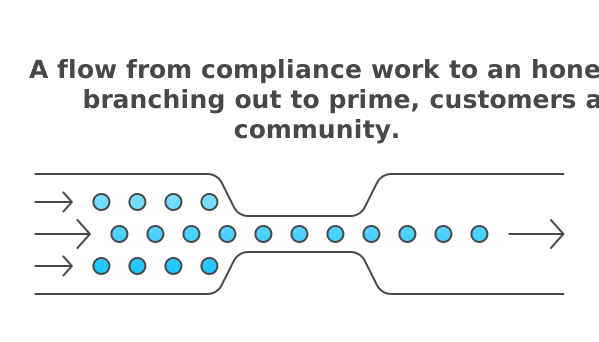
Finishing CMMC work is only half the job. The other half is turning that work into evidence your prime, your customers and your community can see, check and believe.
The timing matters. Quality Magazine reported this week that CMMC assessments are exposing gaps between how ready small defense manufacturers believe they are and what they can prove to an assessor. If you have received in-kind support from Cyber Grants Alliance, or you are thinking about it, how will you tell the story of that work so it opens doors instead of raising doubts?
What does a prime actually check before it trusts a small supplier?
Start with what is written down. The CMMC program rule, 32 CFR Part 170, took effect in December 2024, and the matching DFARS rule began phasing CMMC requirements into new defense contracts in November 2025. When a contract involves Federal Contract Information (FCI) or Controlled Unclassified Information (CUI), it can specify a CMMC level, and that requirement flows down to subcontractors who will handle the same information.
Your CMMC status is recorded in the Supplier Performance Risk System, known as SPRS. A senior official at your company also affirms continued compliance every year. So when a prime asks about you, the questions tend to be practical:
- Do you hold current CMMC status at the level this work needs?
- For Level 2, was it a self-assessment or an assessment by a CMMC Third-Party Assessment Organization (C3PAO)?
- Is there an open plan of action and milestones (POA&M), and when does it close?
- Who at your company signs the annual affirmation?
- When we send a security questionnaire, do you answer with evidence or with adjectives?
That last question is where credibility is won or lost.
Why is a self-reported score not enough to earn trust?
A self-assessment score in SPRS is a number you report about yourself. That is useful, and for many contracts it is exactly what the rule asks for. But primes have seen confident numbers fall apart once someone asks for the proof behind them, and this week's reporting suggests that gap is common among small manufacturers.
There is also a legal edge. The Department of Justice launched its Civil Cyber-Fraud Initiative in 2021 to use the False Claims Act against contractors that misrepresent their cybersecurity. A score that overstates reality does more than embarrass you. It can become a liability for the person who affirmed it.
Compare that with a story that went around this week. Trenton Systems shared that it reached a Level 2 score of 110, the maximum under NIST SP 800-171, and credited its readiness with helping it win a new defense contract and add jobs. The lesson here is less about the number and more about what stood behind it: the company could point to real work and talk about it in public with confidence.
What evidence turns compliance work into something people can see?
Credibility is built from artifacts, not slogans. For a small contractor, these usually persuade people most:
- A System Security Plan (SSP) that describes how your company works today, not a template with your logo on it.
- A simple scoping diagram that shows where FCI or CUI lives and, just as important, where it does not.
- A POA&M that is closed or visibly shrinking, with dates attached.
- Policies your people actually follow, backed by training records.
- An incident response plan you have tested, even if only through a tabletop exercise.
- An evidence folder organized by NIST SP 800-171 requirement, so a question from your prime gets a specific answer the same day.
None of this is marketing material. It is the record, and the credibility story is that record told clearly to the people who need to hear it.
How do you talk about an in-kind grant without overselling it?
Grant recipients sometimes hesitate here. Will mentioning outside help make the company look small? In practice, primes tend to respect suppliers who know where their gaps were and closed them with qualified help. A few habits keep the story honest:
- Say what was done in plain terms: a gap assessment, a rewritten SSP, a scoped enclave, controls put in place and documented.
- Name your status in its exact terms. A Level 2 self-assessment is not a C3PAO certification, and conditional status is not final status. Never round up.
- Say what is still open and when you expect it to close.
- Describe the grant correctly. Cyber Grants Alliance grants are in-kind: experienced practitioners deliver the work and expertise alongside your team, at no cost to you.
- Run anything public past the senior official who signs your affirmation, because their name stands behind it.
When a prime knows exactly where your gaps are, it is more willing to trust everything else you tell it.
Who besides your prime should hear the story?
Your prime is the obvious audience, but it is not the only one.
Commercial customers increasingly send security questionnaires of their own, and the same evidence answers them. Your employees should hear it too, because they keep the controls working day to day. Your community also has a stake. An opinion column in Tucson this week warned that cybersecurity rules could push small movers out of military work. Every small supplier that stays in the defense base keeps skilled jobs and local know-how close to home.
Good places to tell the story include a short security page on your website, a line in your capability statement, a paragraph in proposals, and a standing item at supplier reviews. When did your prime last hear from you about security at a moment when nothing was wrong?
Should you keep going if the CMMC timeline shifts?
This week BPM published guidance on what contractors should do during a pause in CMMC Phase II. The scope and length of any pause are not settled, so check the DoD CIO CMMC page before you change plans. The same Tucson column also noted that the Senate has proposed a grant program in its version of the 2027 National Defense Authorization Act to help contractors with CMMC compliance. That is a proposal, not law, and its final shape is unknown.
Some things do not pause. If you handle CUI under DFARS clause 252.204-7012, the NIST SP 800-171 requirements already apply to you, along with the SPRS self-assessment reporting required by DFARS 252.204-7019 and 7020. As a piece in OT Today put it this week, CMMC is a business decision. The credibility you build now keeps working for you whatever happens to the schedule.
Want help with the first steps? Learn how Cyber Grants Alliance in-kind cybersecurity grants work, at no cost to you, or apply for in-kind support.
Frequently asked questions
What is the difference between being CMMC compliant and being able to show it?
Being compliant means your systems and practices meet the required controls. Being able to show it means you hold documented evidence, such as a current System Security Plan, test records and a closed or shrinking POA&M, that an assessor or prime can verify. Recent assessments suggest many small manufacturers have the first in part but not the second, and primes trust the second.
Can a small contractor say publicly that it received an in-kind grant for CMMC work?
Yes, as long as the statement is true and specific. Describe what the in-kind support delivered, state your CMMC status in its exact terms, and avoid implying a certification you do not hold. Having the official who signs your annual affirmation review the wording is a sensible safeguard.
What should a small defense contractor's security page include?
Keep it short and verifiable: the CMMC level and assessment type you hold, the framework you follow (NIST SP 800-171 for Level 2), a contact for security questions, and how customers can request supporting evidence under a nondisclosure agreement. Do not publish sensitive details such as network diagrams or system names.
Does a perfect SPRS score guarantee that a prime will trust you?
No. A score of 110 is the maximum under NIST SP 800-171, but a self-reported score is only as credible as the evidence behind it. Primes look for documentation, consistent answers and honesty about anything still open. Under the False Claims Act, an overstated score can also create legal exposure.
Should small contractors pause compliance work if CMMC Phase II is delayed?
Generally, no. Contractors handling CUI under DFARS 252.204-7012 already have NIST SP 800-171 obligations no matter where the CMMC phase schedule stands. The details of any Phase II pause are not settled, so confirm current status on the DoD CIO CMMC page and keep building evidence.
Sources
- 32 CFR Part 170, CMMC Program (eCFR)
- DoD CIO, Cybersecurity Maturity Model Certification
- NIST SP 800-171 Rev. 2
- U.S. Department of Justice, Civil Cyber-Fraud Initiative announcement
- Quality Magazine, Small Defense Manufacturers Face a Cybersecurity Reality Check
- OT Today, CMMC Is a Business Decision
- BPM, CMMC Phase II Pause: What Contractors Should Do
- Trenton Systems CMMC post (Instagram)
- This Is Tucson, Opinion: Cybersecurity rules could push small movers out of military work