
Small business cybersecurity training only matters if it changes what your team does every day. Done well, it turns your people into your strongest defense, and your prime can see it.
That point reached Washington recently. Three small business owners told a House panel that CMMC rules are heavy and unclear, as Legis1 reported.
Why does training matter so much for a small team?
In a small shop, everyone wears several hats. The person at the front desk may also manage email for the whole company.
There is no security department to catch a slip. Your people are the security department.
So here is a real question. Who on your team would spot a fake email that looks like it came from a customer?
What does CMMC actually say about training?
CMMC Level 2 is built on a federal standard called NIST SP 800-171, Revision 2. It has a short section on awareness and training. It asks you to:
- Make sure everyone knows the security risks tied to their work.
- Train people for the security duties of their role.
- Teach staff to spot and report signs of insider threats.
Level 1 is a shorter list of 15 basic practices. Training is not one of them, but good habits make those practices easier to keep.
The Department of Defense began adding CMMC to contracts in phases on November 10, 2025. Whether it applies to you depends on what your contract says.
What does small business cybersecurity training change day to day?
The goal is not a certificate on the wall. It is a handful of small habits your team repeats without thinking.
- Pausing before clicking a link in an urgent email.
- Calling a known number to check an odd request, instead of hitting reply.
- Locking the screen when stepping away.
- Using a password manager and a second sign-in step.
- Knowing where controlled unclassified information (CUI) is allowed to live.
- Reporting a mistake right away, without fear of blame.
That last habit may matter most. A team that reports fast can turn a bad click into a small problem.
Why does once-a-year training fade, and what makes it stick?
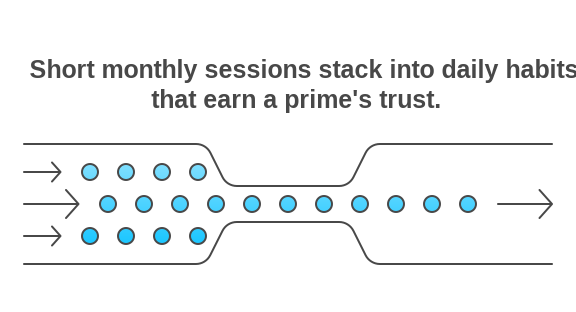
A long yearly slideshow is easy to forget. Habits form through repetition, close to the real work.
Training that sticks tends to share a few traits:
- Short sessions, held often.
- Examples pulled from your own inbox and tools.
- Lessons matched to each person's job.
- An owner who goes first and admits their own close calls.
When did your team last talk about security with no deadline looming?
How does an in-kind grant help with training?
Cyber Grants Alliance gives in-kind cybersecurity grants. The support arrives as work and expertise, at no cost to you.
For training, that can mean help shaped around your own tools, roles and CUI. A trainer can explain the reason behind each rule, not just the rule itself.
That speaks to what the House witnesses described. Unclear rules get much easier to follow once someone walks your team through them.
How do better habits raise my standing with my prime?
Under the CMMC rule, primes must flow requirements down to subcontractors who handle their CUI. Your team's habits become part of your prime's risk.
A supplier whose team handles data with care is easier to trust and easier to keep. Your customers and your local community notice that same care.
If your prime asked tomorrow how your team handles a suspicious email, what would you tell them?
Want help with the first steps? Learn how Cyber Grants Alliance in-kind cybersecurity grants work, at no cost to you, or apply for in-kind support.
Frequently asked questions
Does CMMC require security training?
CMMC Level 2 requires security awareness and training. It uses NIST SP 800-171, Revision 2, which includes three training requirements. They cover general risk awareness, role-based training and insider threat awareness. Level 1 does not list training as its own requirement, but good habits still help you keep its basic practices.
What does this mean for my business?
It means your team's daily habits are now part of your standing with your prime. If you handle CUI under a contract that requires CMMC Level 2, training is a stated requirement. Steady habits also lower everyday risk and show your prime its data is safe with you.
What is an in-kind cybersecurity grant?
An in-kind cybersecurity grant delivers the work and expertise itself, at no cost to you. Experts work alongside your team. That help can include training staff, mapping where CUI lives, or explaining what a rule means for your shop.
How often should a small team train?
Short, regular sessions usually stick better than one long yearly session. The NIST standard leaves the schedule to you. A brief monthly talk is a sensible start. So is training whenever someone joins or changes roles.