
Being the cyber-ready supplier in town makes you the safe choice for your prime, your customers and your neighbors. It is a reputation worth building now, while many local shops are still waiting.
This week brought news of a Justice Department False Claims Act settlement with defense contractors. The case turned on cybersecurity duties they allegedly failed to meet. And CMMC Phase 2 begins November 10.
What does it mean to be the cyber-ready supplier in town?
It means you can show, not just say, that you protect the data people trust you with. You know what data you hold. You have safeguards in place, and you have the records to prove it.
For defense work, that proof follows CMMC. CMMC is the Defense Department's program for checking how contractors protect sensitive information.
Level 1 covers basic contract information and calls for a yearly self-assessment. Level 2 covers Controlled Unclassified Information. Many of those contracts will need an outside assessor.
Why are primes asking about cybersecurity now?
Because the risk lands on them too. Bass, Berry & Sims, a law firm that tracks federal contracting, covered the new settlement. Its takeaway was plain: contractors can face serious liability for missing the cyber rules in their contracts.
Primes pass those rules down to their suppliers. So when a supplier falls short, the prime has a problem.
Timing matters too. Under the CMMC rule, Phase 2 starts November 10, 2026. From then, many new contracts involving Controlled Unclassified Information can require a Level 2 certification from an outside assessor.
Each contract sets exactly when that applies. Some may push it to a later option period.
A prime with a short list of ready suppliers will lean on them first. Would your name be on that list today?
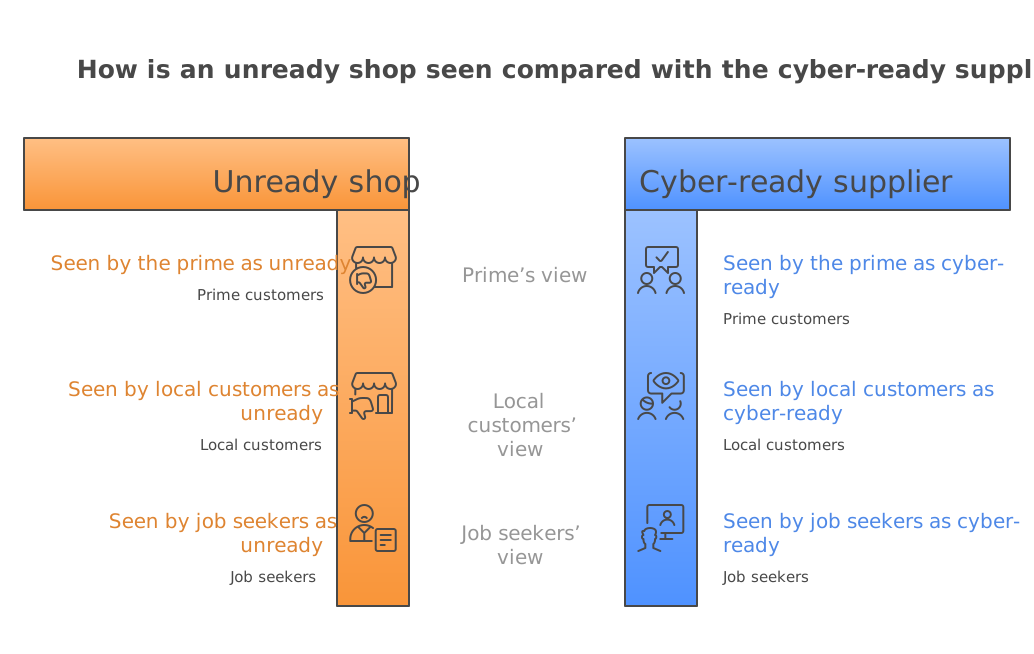
How does being cyber-ready change how my town sees my business?
Word travels in a small town. When you are the shop that did the work, people notice.
- Your prime sees a supplier it can keep, not one it has to replace.
- Local customers see a business that guards their records and orders.
- Job seekers see a steady place with a future in defense work.
- Other small suppliers start asking you how you did it.
That last one matters more than it seems. The business others turn to for advice becomes a leader in its local industry.
States are paying attention too. Connecticut recently launched a Defense CyberSecure Program for its defense suppliers. Programs like that suggest states see local suppliers as worth protecting.
Can a small shop with no IT person really get there?
Yes, though it takes real work and some outside help. Many small suppliers have no security lead on staff. That is normal, not a failing.
This is where in-kind grants can help. Cyber Grants Alliance, a nonprofit, gives in-kind cybersecurity grants. The grant is the work itself, such as a CMMC gap assessment, at no cost to you.
The grant says something about you, too. It shows your prime and your community that you took security seriously and got expert help to do it right.
Where should I start this month?
- List your defense contracts and the kind of data each one involves.
- Ask your prime which CMMC level it expects from you.
- Check whether you have a current score in SPRS, the Defense Department's supplier risk system.
- Write down the safeguards you already have, like multi-factor sign-in.
- Get an outside gap assessment so you know what is missing.
Then ask yourself one honest question. If your biggest customer called tomorrow and asked how you protect their data, what would you say?
Want help with the first steps? Learn how Cyber Grants Alliance in-kind cybersecurity grants work, at no cost to you, or apply for in-kind support.
Frequently asked questions
What does this mean for my business?
It means cyber readiness is becoming part of how primes and neighbors judge you. With CMMC Phase 2 starting November 10, 2026, being ready can help you keep contracts and earn trust. Waiting only makes it harder to catch up.
Do I need CMMC if I am a small subcontractor?
Most likely yes, if you handle Federal Contract Information or Controlled Unclassified Information on a defense contract. CMMC requirements flow down from primes to subcontractors. The level depends on the data you handle, so ask your prime what it expects.
What is an in-kind cybersecurity grant?
An in-kind cybersecurity grant is support delivered as work and expertise. Experts do real security work with you, such as a CMMC gap assessment, at no cost to you. It helps you get ready and shows others you took the work seriously.
Why does the new False Claims Act settlement matter to small suppliers?
It shows the government is enforcing the cyber rules written into defense contracts. Primes carry that risk, so they want suppliers who can prove they meet those rules. A clear, documented security record makes you easier to keep.
Is the CMMC Phase 2 date final?
Yes, the CMMC rule sets Phase 2 to begin November 10, 2026. Each contract still decides when the higher level applies, and some may delay it to a later option period. Ask your prime what your current and upcoming contracts require.
Sources
- DoD CIO, About CMMC
- eCFR, 32 CFR Part 170, CMMC Program
- Federal Register, CMMC Program final rule
- U.S. Department of Justice, Civil Cyber-Fraud Initiative announcement
- Bass, Berry & Sims, DOJ False Claims Act cybersecurity settlement with defense contractors
- CT Manufacturing, Connecticut Defense CyberSecure Program
- Cyber Grants Alliance, in-kind grants and CMMC gap assessments